Use slope stability software when the project calls for it
TSLOPE is built for consultants working on real California projects, where slope stability analysis often happens during specific project phases rather than continuously all year.
Run 2D and 3D limit equilibrium analysis with Day, Week, Month, or Year licences and avoid paying for software that sits idle between jobs.
View a practical exampleWhy consultants stop here
Many slope stability tools push firms toward a large annual software commitment before they know whether the workflow fits the project.
- Software can sit unused between jobs or project phases
- Annual cost is harder to justify against billable work
- Licensing often does not match intermittent modelling needs
- Teams need flexibility when work arrives in bursts
Day licence • Week licence • Month licence • Year licence
Why this matters in California
California projects can involve strong earthquake shaking, irregular geometry, and slopes where 2D sections do not always capture the full picture. When geometry, loading, or site conditions become more complex, checking for 3D effects can support a more defendable decision.
Seismic screening first
Pseudostatic analyses are useful for screening potential slope stability issues during strong earthquake shaking and identifying where closer investigation may be required.
3D effects matter
Variable failure surface geometry relative to the ground surface can provide resistance to sliding that a 2D analysis cannot fully account for.
Consultant workflow
In many cases, engineers already need a 3D model to understand the problem properly and to choose a representative 2D section if one is still useful.
Licensing that fits how consulting work actually happens
Not every project needs 3D analysis. Not every consultant needs a full annual commitment. TSLOPE lets you match the licence to the work in front of you.
Day
For focused project work, checks, and evaluation.
Week
For active modelling phases, review, and iteration.
Month
For live projects that need more room to work through options.
Year
For teams that genuinely need ongoing access across more work.
What matters in practice
- Assumptions used in 2D screening do not always reflect the full 3D problem.
- Variable failure surface shape relative to the ground can add resistance that 2D analysis may miss.
- This also affects the calculation of yield acceleration when using standard pseudostatic limit equilibrium approaches.
- If the factor of safety is close to 1, or there is potential for loss of strength, further numerical analysis may be needed to assess likely displacement.
- Given the uncertainties involved, checking for 3D effects should be routine where geometry or loading suggests they may matter.
How TSLOPE fits that workflow
TSLOPE can work directly with 3D geographical information system data, making it easier to review 3D effects and, where useful, quickly derive 2D analyses to help interpret the result.
That means consultants can use a 3D model to understand the full problem, then still look at 2D sections where they help with communication, checking, or design comparison.
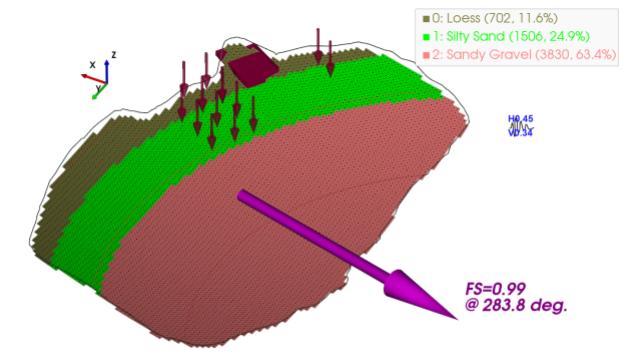
A practical 3D example under strong shaking
This example shows the kind of geometry and loading condition where 3D limit equilibrium analysis can add value beyond a single 2D section.
- A variable 3D failure surface can change the resisting forces available to the slope.
- Irregular geometry and applied loads can influence the stability result in ways that are difficult to represent in 2D.
- Pseudostatic analysis is useful for screening, but slopes close to limiting equilibrium may require more detailed follow-up.
- The aim is a more reliable basis for a project decision when 3D effects matter.
3D limit equilibrium model
A 3D model can help reveal effects that are difficult to represent in a single 2D section, particularly where geometry and loading vary across the slope.
Technical background without cluttering the page
This page stays focused on consultant workflow and licensing. Publications and technical notes are useful supporting proof, but they sit behind the page rather than drive it.
Use TSLOPE on your next project phase
Start with the licence that fits the work in front of you, then scale up only if you need to.