Bench Slope Failure Back Analysis Using 3D Slope Stability
A 3D slope stability case study at Owhiro Bay Quarry using UAV data and TSLOPE to investigate failure geometry, shear strength, and Geological Strength Index (GSI).
Project: Quarry bench failure
Location: Wellington, New Zealand
Method: 3D limit equilibrium (Spencer)
Key result: 3D FS 0.91 vs 2D FS 0.87
Focus: Back analysis + GSI interpretation
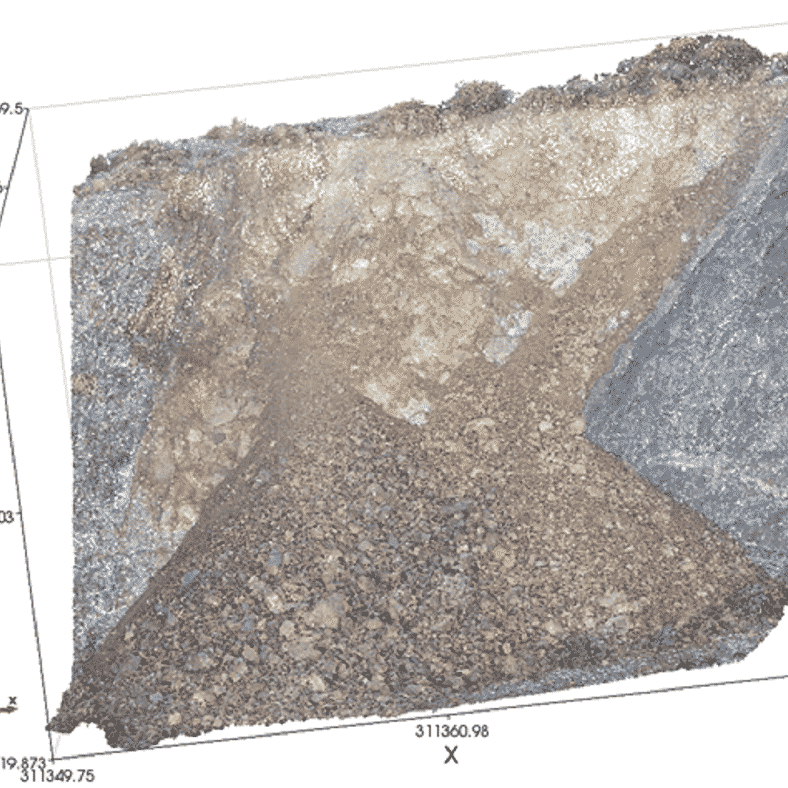 UAV-derived imagery used to build a 3D slope model for back analysis in TSLOPE.
Background
A UAV survey of Owhiro Bay Quarry identified a well-defined shallow bench failure in greywacke rock. This failure was selected for back analysis to better understand shear strength conditions and how Geological Strength Index (GSI) varies along the failure surface.
Modelling Approach
- UAV imagery processed into high-resolution point cloud
- Surfaces generated and cleaned using CloudCompare
- Imported directly into TSLOPE for analysis
- Spencer’s method used for stability calculations
Results
The 3D analysis produced a factor of safety of 0.91, compared to 0.87 using a 2D section.
Why this matters
3D slope stability analysis can materially change your interpretation of failure mechanisms. Using UAV-derived geometry allows engineers to better represent real slope conditions and avoid underestimating risk.